International faculty at HSE are involved not only in research and teaching, but some also combine it with active participation in the city’s public discussion spaces. The HSE Look took an interview with Jan Surman, Research Fellow at Poletayev Institute for Theoretical and Historical Studies in the Humanities (IGITI), about his research and Cultures of Critique project.
HSE Assistant Professor of Philosophy, Aaron James Wendland, recently launched a popular philosophy column in a prominent British Magazine: The New Statesman. In this interview, we ask Aaron about his research interests, his experience at HSE, and the rationale behind his new column on popular philosophy.
Dr Anna Whittington is currently a Research Fellow at The International Centre for the History and Sociology of World War II and Its Consequences through the end of August 2019. She recently spoke with the HSE News Service about her work on changes in Soviet-era language policy, her thoughts on life in Moscow and how the city has changed, and much more.
Early this summer, the HSE community was surprised to learn about its newest colleague: a robot helper named Isaac tasked with recording and scoring the publications by researchers and faculty. Isaac is constantly learning to improve its algorithms and interface, and now that it’s learned English, we are happy to share with The HSE Look readers the exclusive interview with Isaac taken by Okna Rosta, where he talks about his functions and even offers some words of advice.
Natalia Lyskova is spending her 2nd year as a postdoc at HSE Faculty of Physics working in a Joint Department of Space Physics with the Space Research Institute at the Russian Academy of Sciences, and told The HSE Look about the ongoing research in astrophysics and upcoming plans.
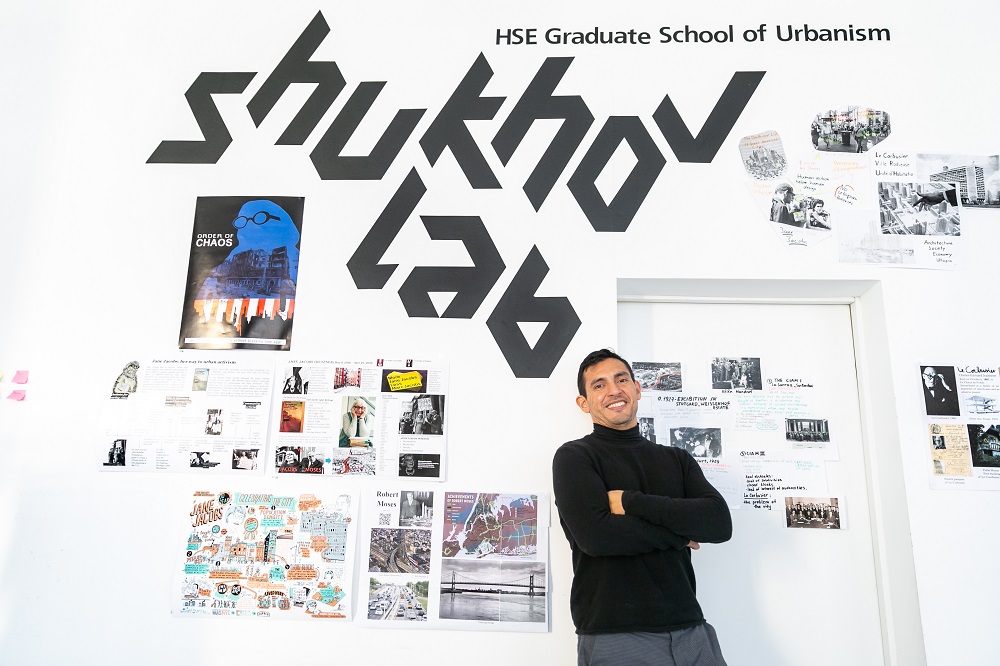
Benito Juarez, the founder of the first Fab Lab in South America and the Latin America Fab Lab Network, has come to HSE University for the 2018 autumn semester as an invited lecturer on Master’s Programme in Prototyping Future Cities. He is delivering a course in Impact Analysis for first-year students and leading the City Project module, a practical component of the Master’s programme. Mr Juarez has talked to HSE News Service about fab lab projects, creative cities of the future, and the courses he is teaching at HSE.
In October, the International Laboratory on World Order Studies and the New Regionalism hosted a research seminar in which Dr. Glenn Diesen, Professor in the Faculty of World Economy and International Affairs at HSE, presented a recent paper entitled ‘Geoeconomics in the Fourth Industrial Revolution: The Restructuring of Global Value Chains.’ The discussion centred on how technology has become increasingly important for competitiveness in global value chains. This subsequently incentivizes government support for technological development as the main tool for Great Power rivalry, which can be seen in the cooperation between Western governments and corporations over the past several decades to develop technological leadership with high-value activities and concurrently engineer hierarchically-structured global value chains.
Values have a great influence in our life. They play a constant role in economics, politics and societies or in disciplines like philosophy, psychology, religion, and sociology. They are fundamental in the construction of a good life for every individual, for achieving quality of life, and for finding meaning.
Kristian Behrens serves as Leading Research Fellow at the HSE Centre for Market Studies and Spatial Economics (CMSSE) and Academic Supervisor at the Centre for Interdisciplinary Basic Research at HSE St. Petersburg. Professor Behrens focuses primarily on regional and urban economics, new economic geography, international and interregional trade, multiregional spatial and urban systems, and monopolistic competition. He recently spoke with the HSE New Service about the work currently being undertaken by CMSSE, his broader research interests, and his impressions of working in St. Petersburg.
An intercultural seminar on specifics of living and working in Russia was held by Dr. Mira Bergelson, a Professor of Linguistics, on September 25th at the Higher School of Economics in Moscow for internationally recruited faculty members.